
Orbiton vibrating lamella: from working prototype to a manufacturable, performance-led design
Orbiton had already proved its acoustic keyboard concept with a working prototype. Focused Phase 0 studies and ongoing technical input then developed a secure tip-mass and tuning method, profiled lamella geometry and supplier-ready prototype candidates, supported by a frequency-correlated parametric analysis model.
Phase 0
Musical instruments
Component redesign
Performance & manufacturability
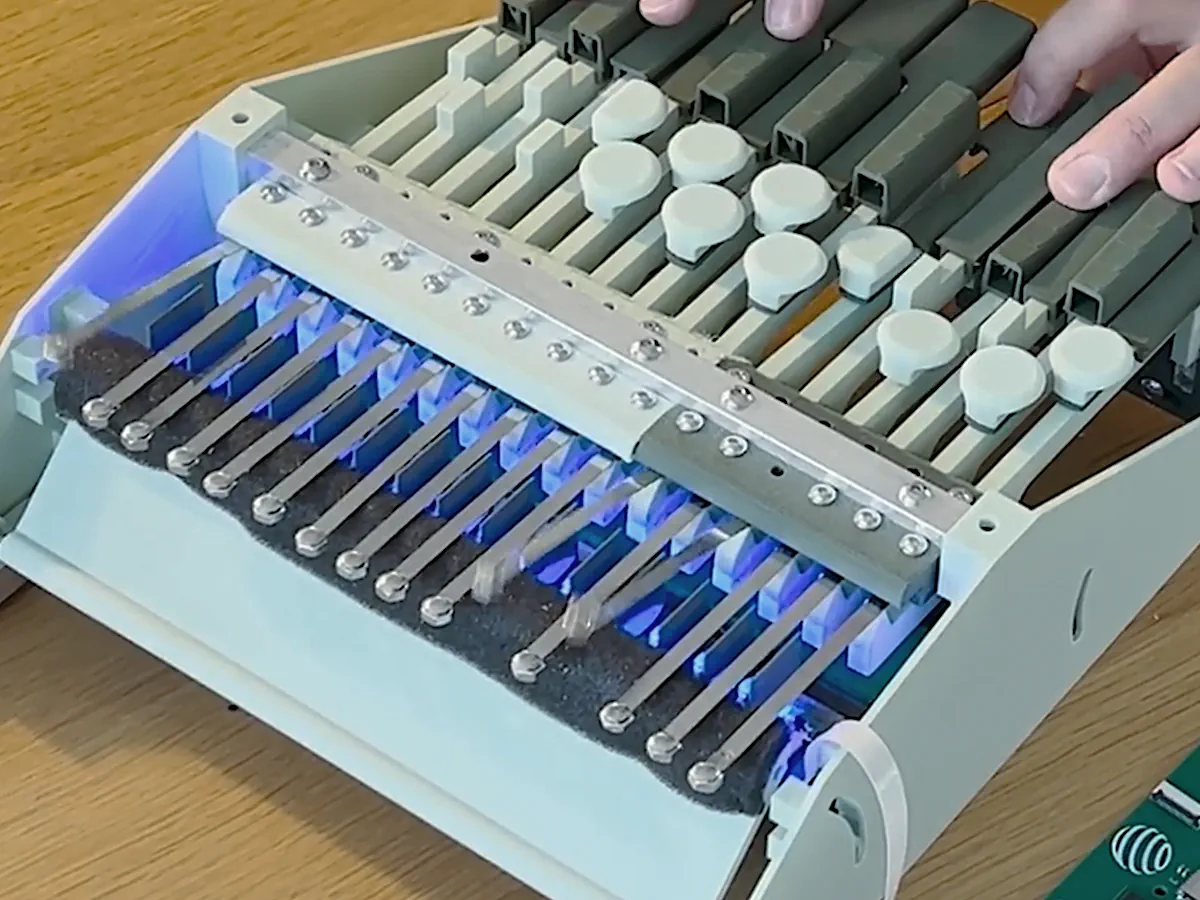
Orbiton keyboard prototype being played, using the riveted tip masses developed during the work
Situation
Orbiton Sound Limited is developing an acoustic musical interface in which physical lamellas are set into vibration when a key is pressed. Their motion allows the onboard synthesiser to respond continuously to the player’s gestures, creating a more tactile and organic connection than a conventional velocity-sensitive keyboard.
Orbiton had already developed a working prototype using plain rectangular lamellas with its industrial-design team. The prototype successfully demonstrated the wider product principle. The next step was to establish a more predictable, repeatable and manufacturable mechanical basis for a planned pilot production run.
Frugal supported Orbiton through a series of focused Phase 0 commissions and ongoing technical input. The early work addressed an immediate problem with attaching and controlling small tuning masses carried at each lamella tip. Subsequent work established the wider lamella design basis, investigated its dynamic behaviour and developed candidates for the next round of physical prototype testing.
The real problem
The initial challenge was to attach the tip masses reliably while controlling their assembled mass accurately and repeatably. Variations in the lamella, attached components and assembly process affected the final dynamic behaviour, making consistent manufacture and tuning a real challenge.
Once that problem had been addressed, a wider challenge was to improve the lamella itself. Each lamella needed to operate within narrowly predefined frequency constraints and sustain that motion for as long and as cleanly as practicable, because the quality and consistency of its decay directly shaped the instrument’s feel and expressive response.
Orbiton had already developed the plain rectangular lamellas using its own Python calculation model alongside extensive empirical prototyping. This had taken the uniform-section concept a considerable way, but further gains in decay performance required a different geometric approach.
Each lamella also operated in two distinct playing modes, creating materially different boundary conditions that needed careful consideration. Exploring the resulting design space through one-at-a-time physical prototyping, sequential hand calculations or individual FEA models would have been slow, expensive and unlikely to reveal the full interaction between all the variables.
Constraints
-
Frequency requirements: the lamellas needed to meet specific frequency requirements while preserving a fast, responsive and natural playing feel and reducing player fatigue.
-
Two playing modes: the same component operated under two distinct restraint conditions, whose different and sometimes competing dynamic effects had to be balanced.
-
Decay performance: avoidable vibration-energy losses through geometry and material behaviour, interfaces and local stress effects needed to be understood and minimised through design.
-
Controlled variation: material, component and assembly variation had to be quantified and accommodated by design, through appropriate tuning or compensation mechanisms.
-
Developing interfaces: the final clamping arrangement did not yet exist, so the analysis needed to define an assumed but workable interface detail without constraining its onward development.
-
Prototype economics: hundreds of analytical possibilities had to be reduced to a small set that could be manufactured and tested economically.
Client:
Orbiton Sound Limited (opens in a new tab)
Role:
Senior mechanical engineering consultant
Period:
February 2026 to present
Scope:
Tip-mass attachment +
Dynamic design basis +
Parametric geometry optimisation +
Prototype 3D models & drawings
Acceptance basis:
Baseline frequency correlation +
Selected FEA cross-checks +
Client prototype observations
Key moves
Establishing the mechanical design basis
- Mapped the relationships between geometry, mass, stiffness, frequency, decay and the principal vibration-loss mechanisms.
- Represented both playing modes using their distinct boundary conditions and established criteria for screening candidate designs.
Solving attachment and tuning
- Developed a secure and repeatable tip-mass attachment design using standard, commercially available components.
- Defined a practical tuning method that compensated predictably for material, component and assembly variation.
Introducing profiled lamellas
- Proposed a narrow-waisted 2D profile that redistributed mass towards the tip while allowing the stiffness and mass distribution to be engineered at design stage.
- Developed a provisional clamp-side concept and the interface assumptions needed for credible analysis and onward design.
Screening candidates at scale
- Built a bespoke Python calculation model, checked against physical frequency measurements and cross-checked using FEA.
- Screened hundreds of parameterised geometries, using the findings from each round to refine the next.
- Selected a small set of the most promising candidates and issued supplier-facing drawings and DWG profiles for prototyping.
Selected snapshots
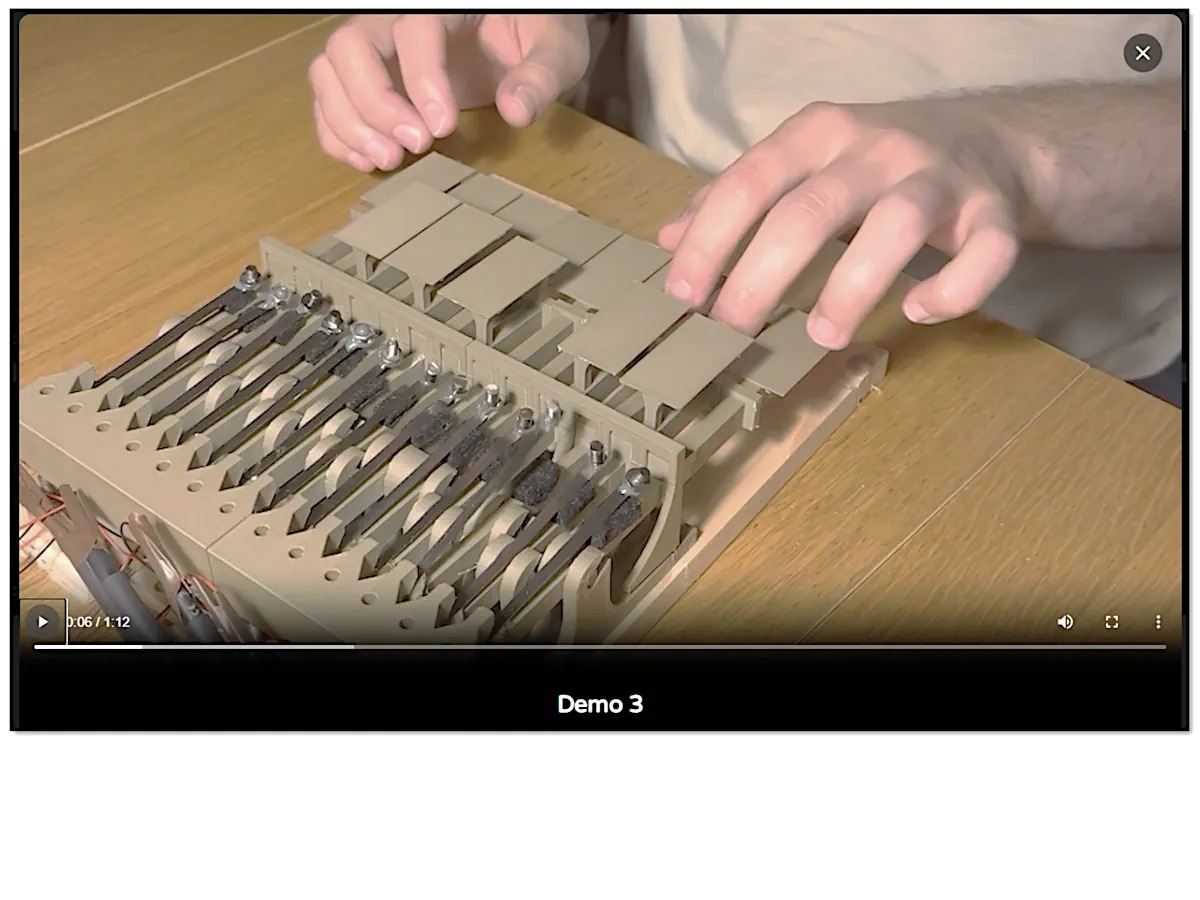
Before Frugal became involved, Orbiton had already developed the electronics, software and working keyboard prototype, proving the concept and establishing the case for further investment in engineering design.
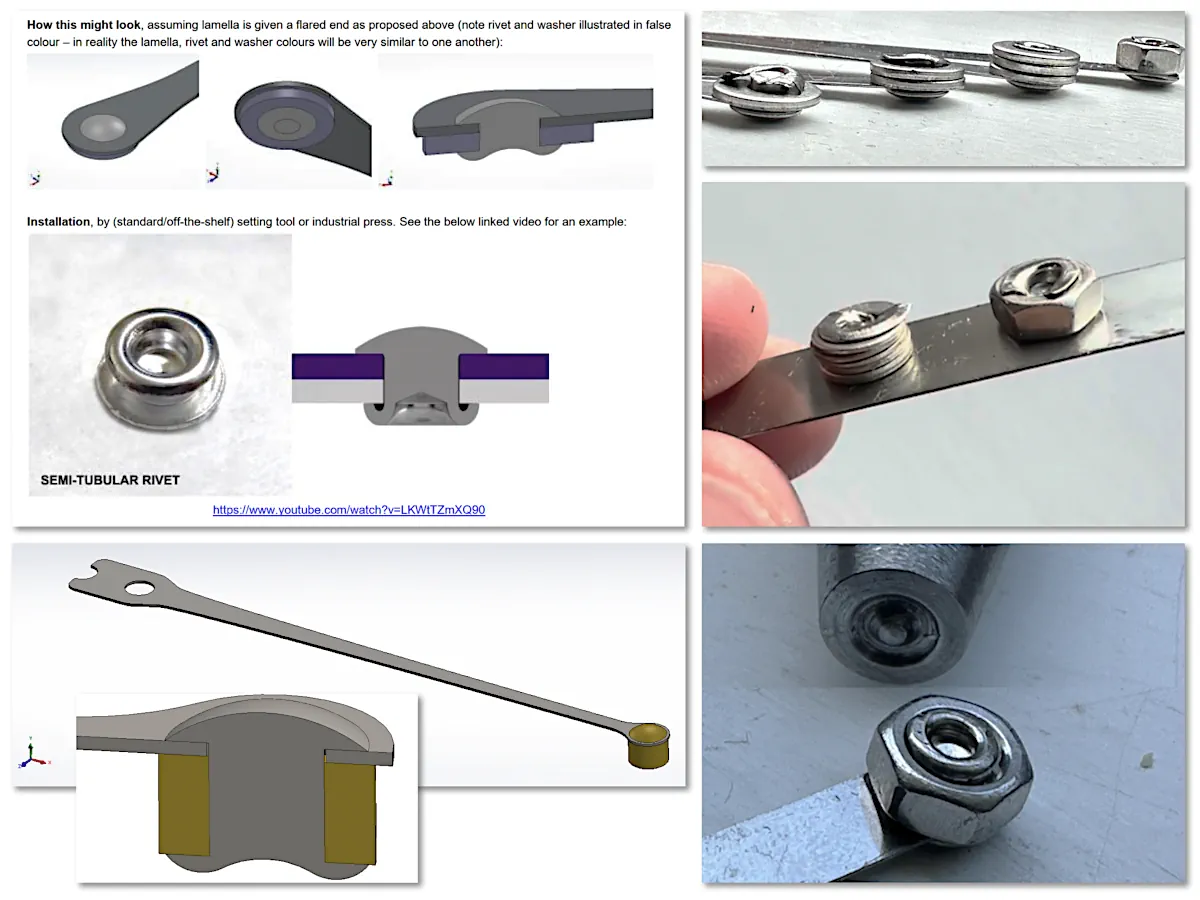
The first task for Frugal was to generate several blank-sheet concepts for securely and repeatably attaching each lamella’s tip mass. The illustrated rivet-based option was then developed further and adopted into the design.
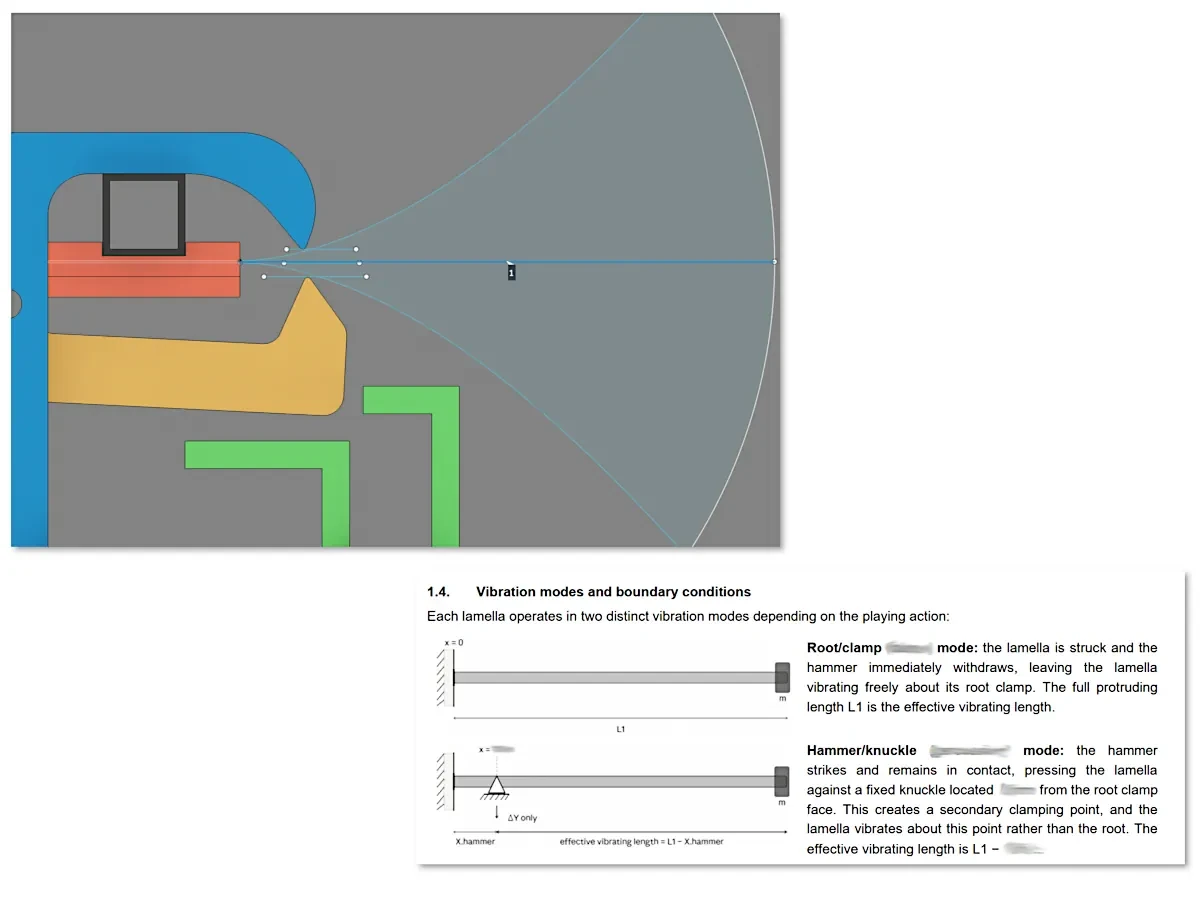
The lamella operated in two playing modes, represented by materially different restraint conditions whose competing physical and dynamic demands had to be balanced.
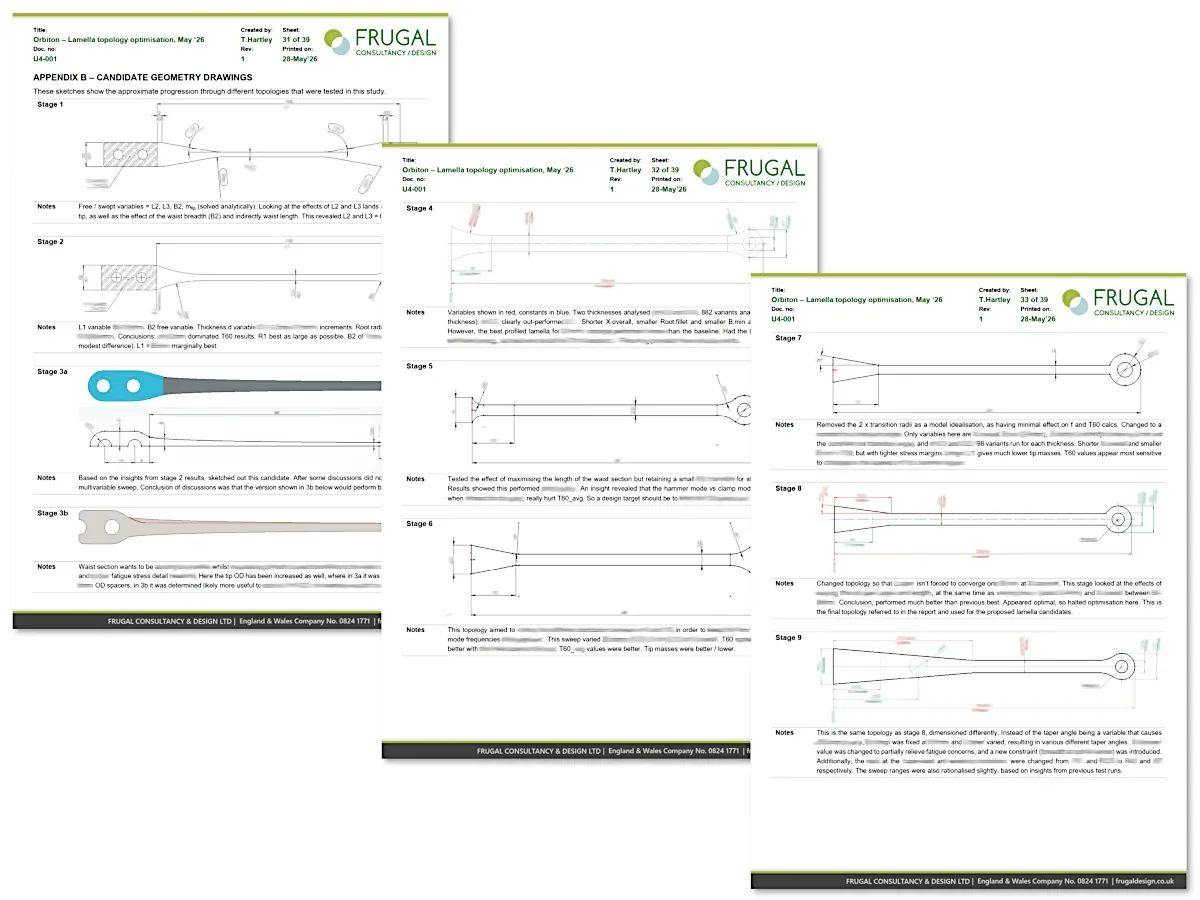
Each successive parameterised profile topology was explored through hundreds of candidate variations, with the results and engineering judgement guiding the geometry developed for the next stage.
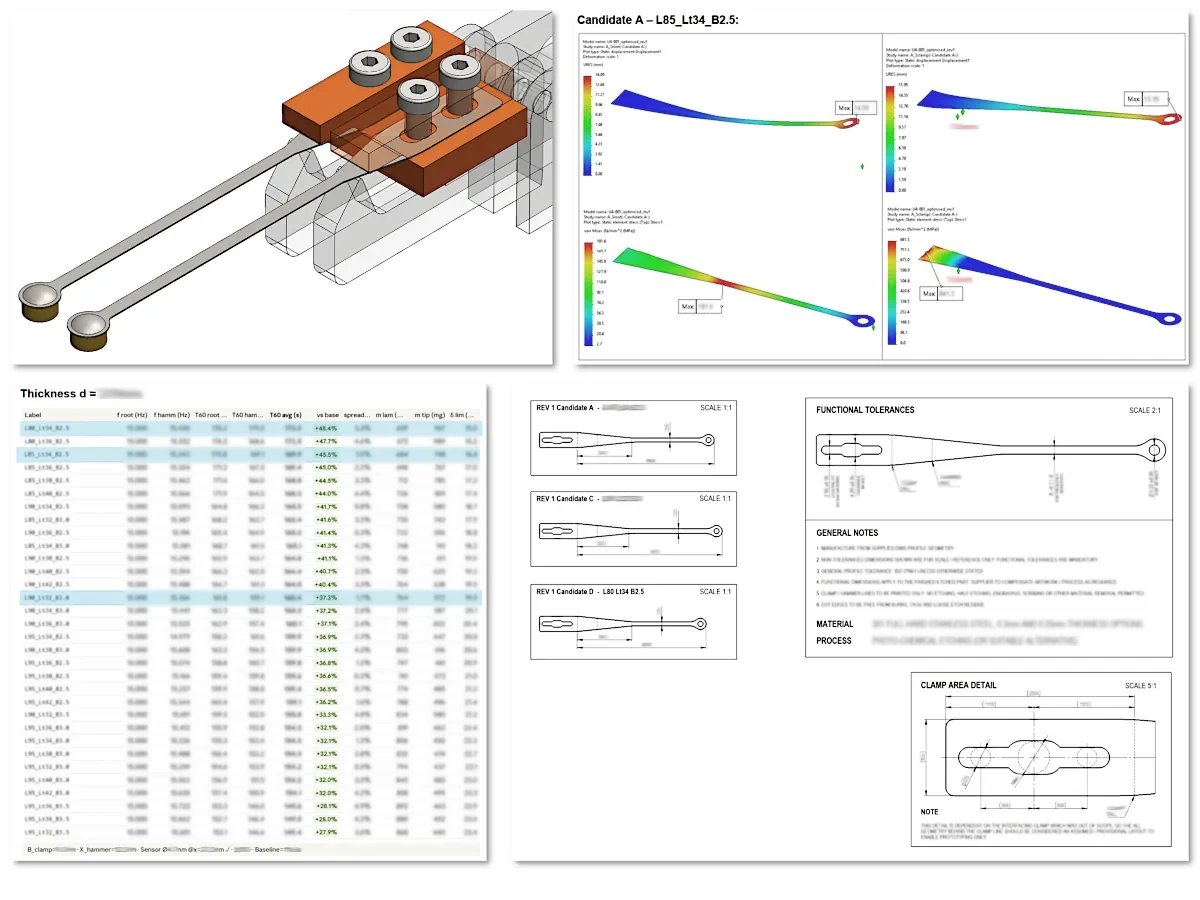
Predicted frequency and decay performance were generated for each candidate, allowing hundreds of geometries to be ranked and reduced to a small prototype set, cross-checked using FEA and issued as prototype drawings.
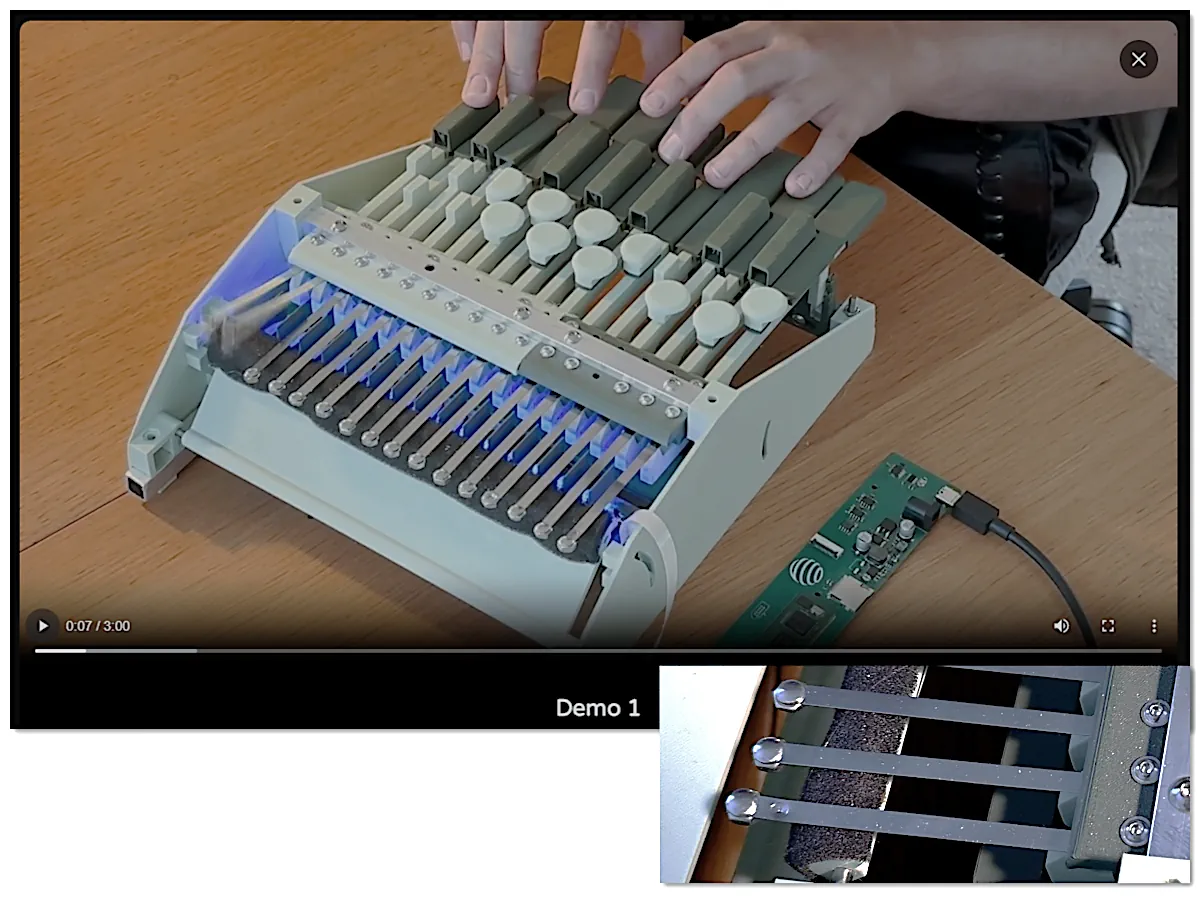
Orbiton prototyped the tip-mass concept and adopted it into its instrument designs. It also manufactured and tested selected profiled lamellas and is incorporating them into its next-generation designs.
Outcome
Orbiton prototyped the proposed tip-mass attachment arrangement and found that it worked well. It resolved the original attachment, mass-control and repeatability problems and was adopted into the client’s subsequent prototype designs.
The lamella optimisation study reduced hundreds of analytical candidates to a small set of supplier-ready geometries for physical testing and comparison. Across eight baseline frequency measurements, the Python vibration model achieved a mean absolute percentage error of 1.8%, providing a credible basis for comparative candidate screening.
The strongest profiled candidates were analytically predicted to extend T60 decay time by almost 50% relative to the original plain-strip baseline. Orbiton’s initial testing found the manufactured candidates very promising and indicated an obvious qualitative improvement in decay performance. Quantitative physical measurement of the improvement has not yet been completed.
What this enabled
Beyond the commissioned outputs, Orbiton gained ongoing access to senior mechanical engineering input as the keyboard hardware continued to evolve. Frugal could challenge assumptions, assess emerging ideas and translate new requirements into practical design decisions without the underlying engineering basis having to be rebuilt each time.
This helped Orbiton move beyond iterative refinement of the original rectangular-lamella concept towards a more deliberate and manufacturable keyboard architecture. Combined with Orbiton’s established electronics and software capability, Frugal’s mechanical design input provided a stronger route for advancing the controller hardware and defining subsequent prototype generations.
Client feedback
“Working with Tom has been genuinely valuable to our product. His input has been especially helpful at this early stage of development, when critical decisions are being made.
His technical work is precise and well thought out, and his communication throughout has been clear and reliable.
Tom quickly understood the broader context of the lamella and the implications of its use in a musical instrument.
He is the engineer I turn to when a problem is genuinely difficult, and working with him gives me confidence that it will be solved properly.”
Mihai Traista, Founder
Orbiton Sound Limited, London
Got an engineering design problem to solve?
Tell me what you’re dealing with and I’ll let you know whether I can help.